
By Prof. Guy Doron and Dr. Danny Derby, Relationship OCD Research Unit. Updated October 2026.
Relationship obsessive-compulsive disorder (ROCD) is a presentation of OCD in which intrusive doubts and compulsive behaviors center on a close relationship. The cognitive-behavioral model of ROCD, first set out in 2014 (Doron, Derby & Szepsenwol, 2014), explains why an ordinary thought such as “I feel bored with her” can turn into hours of checking, comparing and reassurance-seeking. In brief, the model holds that the problem is not the content of the doubt but the meaning it is given and the responses it sets off, and that these are shaped by general OCD beliefs together with vulnerabilities specific to love, relationships and the self.
Two presentations of ROCD
Research and clinical work describe two main presentations, which often appear together and feed each other (Doron et al., 2012a; 2012b):
- Relationship-centered symptoms: doubts about one’s own feelings toward the partner, about the partner’s feelings, and about whether the relationship “feels right”.
- Partner-focused symptoms: preoccupation with perceived flaws in the partner, most often in appearance, sociability, morality, emotional stability, intelligence or competence. The trait does not have to be imagined. What marks ROCD is the repeated preoccupation with it, the threatening meaning it is given, and the need to keep checking what it says about the partner, the relationship or oneself.
Doubts may also take the form of images or sudden urges, for example a vivid picture of a partner’s feature or an urge to break up. An urge like this is not necessarily a considered decision. It can be an attempt to end the doubt and the distress it brings.
The ROCD cycle
The model describes a loop. A trigger, such as a quiet dinner, a wedding or an attractive colleague, brings up an intrusive thought, image or urge. The intrusion is appraised as meaningful (“If I’m bored, it isn’t real love”), which leads to anxiety, guilt or shame and a pressing need for certainty. The person then responds with compulsions: monitoring their feelings, comparing the partner or relationship with others, replaying conversations, deliberating, or seeking reassurance. These responses may bring brief relief or a sense of “dealing with the problem”, but they also make each sign seem more important, so the next trigger meets a more watchful mind.
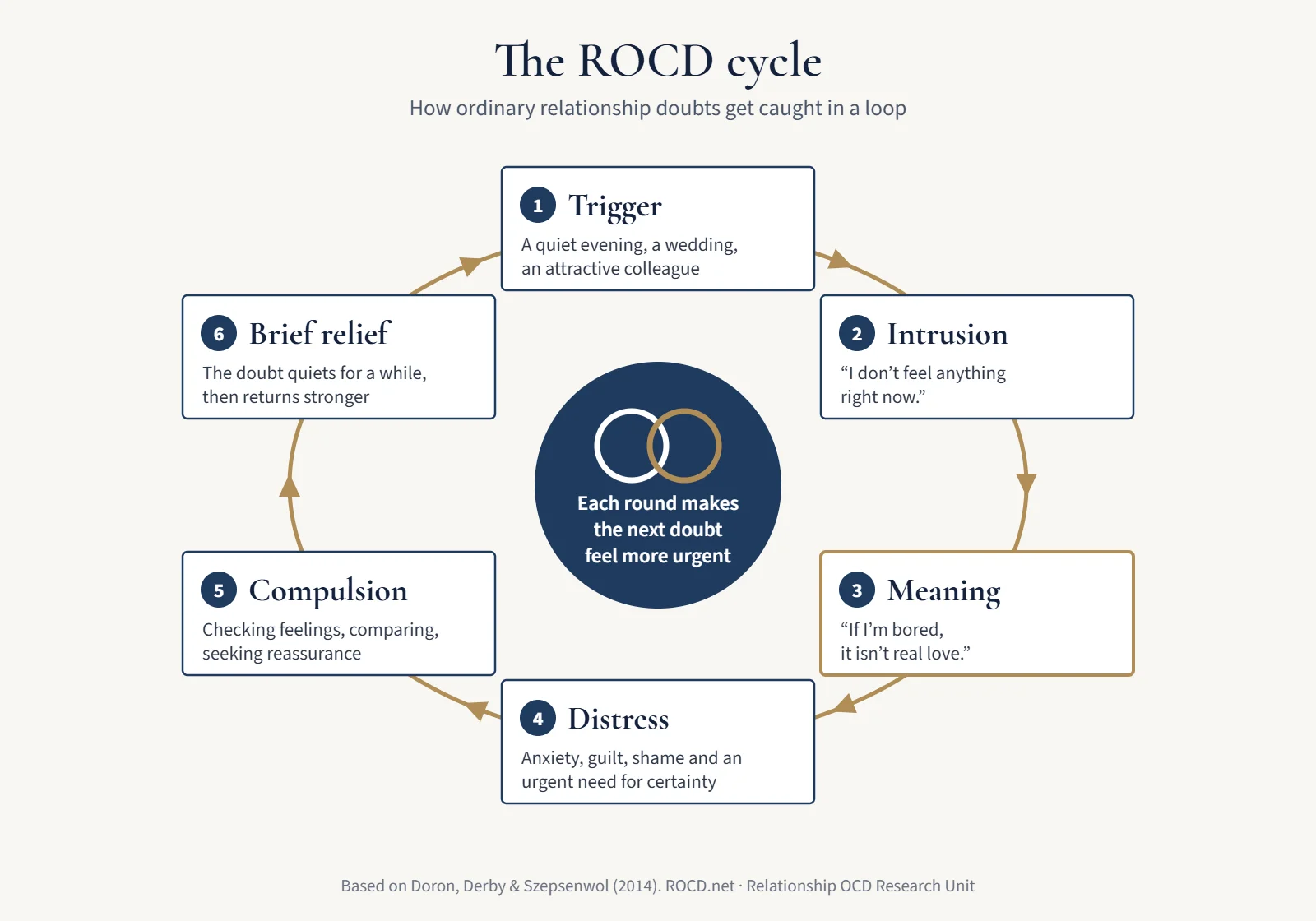
A clinical example: during an ordinary evening, the thought “I am bored” appears. It is read as “Maybe I don’t love him, and if I stay I will regret it forever.” The response is to check, again and again, whether the feeling of love is there. The checking itself makes the feeling harder to find, and the evening is spent inside the question rather than with the partner.
What makes the doubt feel so loaded
The model proposes that general OCD processes are joined by factors tied specifically to relationships and the self. These factors are not the same in every person, which is why assessment and treatment are individual and modular.
General OCD beliefs
As in other presentations of OCD, people with ROCD may find uncertainty hard to tolerate, hold perfectionistic standards and an inflated sense of responsibility, give thoughts too much importance, and overestimate threat. Concern over mistakes and doubts about actions predicted relationship-centered symptoms in a clinical sample (Melli et al., 2018), and other research groups have linked ROCD symptoms to intolerance of uncertainty and perfectionism (Toroslu & Çırakoğlu, 2022) and to deontological guilt (Tinella et al., 2024).
Beliefs about love and catastrophic relationship beliefs
Personal theories about love often set the rules for what gets checked: “When it’s the right person, you just know”, “Being attracted to someone else proves something is missing”, “A good relationship shouldn’t need work.” Catastrophic beliefs about being in the wrong relationship or ending up alone predicted ROCD symptoms in clinical and non-clinical samples (Doron et al., 2016; Melli et al., 2018).
Self-worth that depends on the relationship or the partner
A doubt becomes more threatening when it touches an area where a person’s self-worth is vulnerable. The combination of attachment anxiety and self-worth that depends on the relationship was linked to more severe relationship-centered symptoms (Doron et al., 2013). In partner-focused ROCD, self-worth may depend on the perceived value of the partner: in an experiment, thinking of the partner as inferior affected the self-esteem of people high in partner-focused symptoms (Doron & Szepsenwol, 2015). A related finding in a Turkish sample is reported by Trak and İnözü (2019).
Attachment insecurity
Attachment anxiety can heighten alertness to signs of rejection and encourage repeated reassurance-seeking. Attachment is not an alternative explanation for ROCD. It helps explain why a doubt carries so much weight and why certain ways of coping connect with the compulsive loop.
Fear of regret
Many people with ROCD move between two scenarios: staying in the wrong relationship and realizing it too late, or leaving the right person and regretting it forever. When the goal is a decision that can never be regretted, no amount of information is enough. Anticipated regret was proposed in the 2014 framework as a maintaining factor. It has not yet been tested as a separate variable.
How the responses keep the cycle going
Many ROCD compulsions are mental: monitoring feelings, comparing, replaying conversations, searching for the “right feeling”, or building a story that should end with a reassuring conclusion. Deliberation often acts as the organizing compulsion, turning every detail into data for a decision that never closes. Some people are less troubled by the question “Do I love my partner?” and more by a feature that feels jarring or “not right”, and respond by checking, hiding, avoiding or trying to change it.
These responses strengthen the beliefs behind them. A person who keeps comparing the partner makes the partner’s traits even more central to their own worth, and a person who turns to reassurance each time never learns that the doubt can be carried. The relationship itself can become part of the cycle when the partner is drawn into reassurance and checking; early findings also point to possible transmission of symptoms between partners (Littman et al., 2023). ROCD symptoms have been linked to distress and impairment comparable to other presentations of OCD (Doron et al., 2016) and to lower sexual satisfaction (Doron, Mizrahi et al., 2014).
How each part of the model is measured
The unit developed questionnaires for the main components of the model, available for research and clinical use:
- ROCI: relationship-centered symptoms.
- PROCSI: partner-focused symptoms.
- Relationship Catastrophization Scale (RECATS): catastrophic beliefs about relationships.
- Extreme Love Beliefs Scale (EXLS): rigid beliefs about love.
- Relationship contingent self-worth and partner value contingent self-worth: self-worth that depends on the relationship or the partner.
- Obsessive Beliefs Questionnaire (OBQ): general OCD beliefs.
See all ROCD measures.
What the model means for treatment
Because the cycle is maintained by meaning and responses, treatment does not try to settle whether the relationship is right. It works on the cycle: reducing checking, comparing and reassurance-seeking, exposure and response prevention, behavioral experiments that test beliefs about love and regret, and work on the self-vulnerabilities that give the doubt its weight. Treatment does not aim to persuade a person to stay or to leave. The modular CBT approach is described by Doron and Derby (2017). Read more about ROCD assessment and treatment.
Limits of the model
Most of the findings behind the model are correlational and do not establish cause. The model also does not mean that every doubt is a symptom. Real difficulties in a relationship deserve real attention, and concerns about safety, abuse or coercion should never be dismissed as “just ROCD”. An assessment by a professional trained in CBT for OCD looks at both the cycle and the actual relationship.
The original 2014 presentation
The model was first presented in slides by the ROCD Research Unit in 2014. You can download the original presentation (PDF, 3 MB). The page above reflects the research published since then.
Frequently asked questions
What causes ROCD?
There is no single cause. The model describes how general OCD processes, such as difficulty tolerating uncertainty and giving thoughts too much importance, combine with vulnerabilities related to relationships, such as rigid beliefs about love, self-worth that depends on the relationship or the partner, and attachment insecurity. These factors differ from person to person, and most of the evidence is correlational.
How is ROCD different from ordinary relationship doubts?
Doubts are a normal part of close relationships. In the model, what matters is less the content of the doubt and more what happens after it: whether it is given a threatening meaning and sets off repeated checking, comparing or reassurance-seeking that brings only brief relief. In ROCD, this cycle causes marked distress and interferes with daily functioning, with the relationship and with the ability to pursue what matters to the person and to fulfil their potential. No checklist can settle this for a particular relationship.
Does the ROCD model tell me whether my relationship is right?
No. The model explains how doubts become a compulsive cycle. It cannot answer whether a specific relationship is right, and treatment based on it does not try to answer that question either.
References
- Doron, G., & Derby, D. (2017). Assessment and treatment of relationship-related OCD symptoms (ROCD): A modular approach. In J. S. Abramowitz, D. McKay, & E. A. Storch (Eds.), The Wiley handbook of obsessive compulsive disorders (pp. 547-564). Wiley.
- Doron, G., Derby, D. S., & Szepsenwol, O. (2014). Relationship obsessive-compulsive disorder (ROCD): A conceptual framework. Journal of Obsessive-Compulsive and Related Disorders, 3(2), 169-180. https://doi.org/10.1016/j.jocrd.2013.12.005
- Doron, G., Derby, D., Szepsenwol, O., Nahaloni, E., & Moulding, R. (2016). Relationship obsessive-compulsive disorder: Interference, symptoms, and maladaptive beliefs. Frontiers in Psychiatry, 7, 58. https://doi.org/10.3389/fpsyt.2016.00058
- Doron, G., Derby, D. S., Szepsenwol, O., & Talmor, D. (2012a). Tainted love: Exploring relationship-centered obsessive compulsive symptoms in two non-clinical cohorts. Journal of Obsessive-Compulsive and Related Disorders, 1(1), 16-24. https://doi.org/10.1016/j.jocrd.2011.11.002
- Doron, G., Derby, D. S., Szepsenwol, O., & Talmor, D. (2012b). Flaws and all: Exploring partner-focused obsessive-compulsive symptoms. Journal of Obsessive-Compulsive and Related Disorders, 1(4), 234-243. https://doi.org/10.1016/j.jocrd.2012.05.004
- Doron, G., Mizrahi, M., Szepsenwol, O., & Derby, D. (2014). Right or flawed: Relationship obsessions and sexual satisfaction. Journal of Sexual Medicine, 11(9), 2218-2224. https://doi.org/10.1111/jsm.12616
- Doron, G., & Szepsenwol, O. (2015). Partner-focused obsessions and self-esteem: An experimental investigation. Journal of Behavior Therapy and Experimental Psychiatry, 49, 173-179. https://doi.org/10.1016/j.jbtep.2015.05.007
- Doron, G., Szepsenwol, O., Karp, E., & Gal, N. (2013). Obsessing about intimate relationships: Testing the double relationship-vulnerability hypothesis. Journal of Behavior Therapy and Experimental Psychiatry, 44(4), 433-440. https://doi.org/10.1016/j.jbtep.2013.05.003
- Littman, R., Leibovits, G., Netzach Halfon, C., Schonbach, M., & Doron, G. (2023). Interpersonal transmission of ROCD symptoms and susceptibility to infidelity in romantic relationships. Journal of Obsessive-Compulsive and Related Disorders, 36, 100802. https://doi.org/10.1016/j.jocrd.2023.100802
- Melli, G., Bulli, F., Doron, G., & Carraresi, C. (2018). Maladaptive beliefs in relationship obsessive compulsive disorder (ROCD): Replication and extension in a clinical sample. Journal of Obsessive-Compulsive and Related Disorders, 18, 47-53. https://doi.org/10.1016/j.jocrd.2018.06.005
- Tinella, L., Ricciardi, E., Cosentino, T., Caffò, A. O., Doron, G., Bosco, A., & Mancini, F. (2024). Deontological guilt mediates the effects of personality on the symptoms of romantic relationship obsessive compulsive disorder (ROCD). Clinical Neuropsychiatry, 21(3), 205-216. https://doi.org/10.36131/cnfioritieditore20240306
- Toroslu, B., & Çırakoğlu, O. C. (2022). Do perfectionism and intolerance of uncertainty mediate the relationship between early maladaptive schemas and relationship and partner related obsessive-compulsive symptoms? Current Psychology, 42, 19037-19053. https://doi.org/10.1007/s12144-022-03050-w
- Trak, E., & İnözü, M. (2019). Developmental and self-related vulnerability factors in relationship-centered obsessive compulsive disorder symptoms: A moderated mediation model. Journal of Obsessive-Compulsive and Related Disorders, 21. https://doi.org/10.1016/j.jocrd.2019.03.004
Related: Our ROCD papers · The ROCD Research Unit · Do I have ROCD?