

Apps and Digital Self-Help: ocd.app, Thinkable and the GG Apps
Updated: 28 October 2026
Digital exercises can offer a structured way to practise responding differently to intrusive thoughts and rigid beliefs. This page brings together the apps discussed on ROCD.net, explains their relationship to the research, and distinguishes current resources from earlier products.
ocd.app: the current public self-help resource
ocd.app provides brief cognitive behavioural exercises, including material for relationship OCD. The current platform also describes content for OCD, anxiety, depression, self-esteem, body image, trauma-related difficulties and chronic pain. Users practise recognising unhelpful interpretations and responding more flexibly, with short daily exercises and progress monitoring. Availability of individual tracks and languages should be checked with the developer.
The app is developed by GGtude, whose research leadership includes Prof. Guy Doron. For current downloads, supported devices, free access and subscription terms, use the official website rather than old app-store links on historical posts.
A look inside ocd.app
Official screenshots offer a glimpse of the exercises and learning tracks.
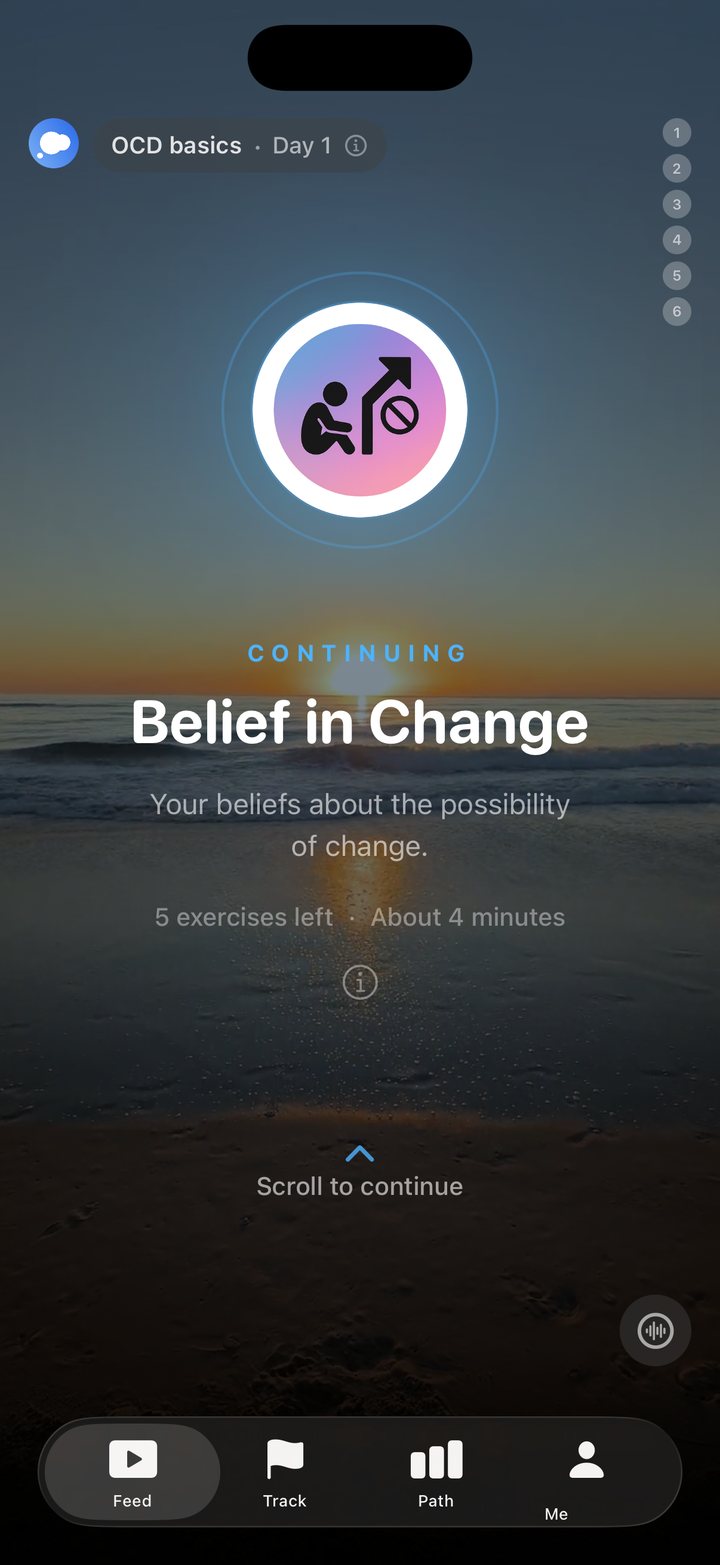
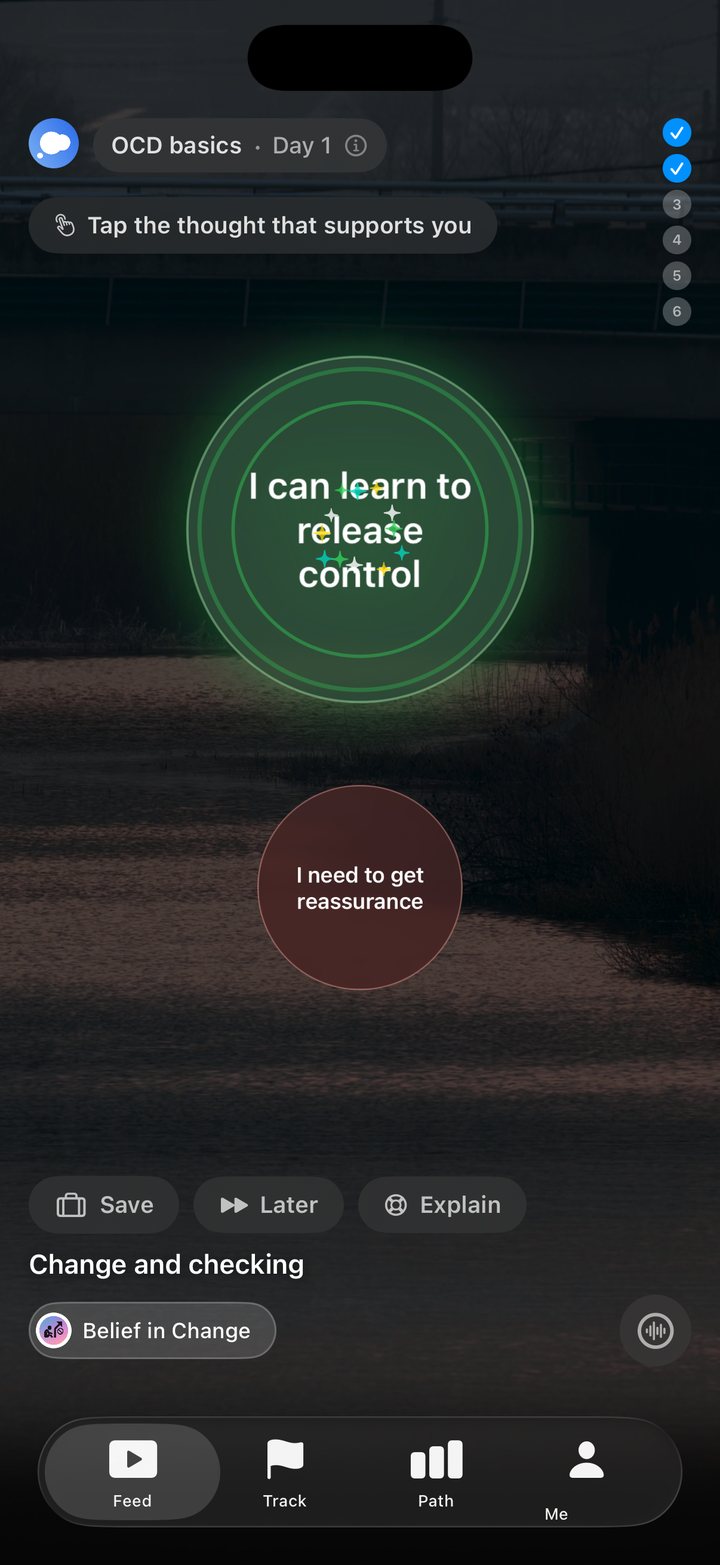
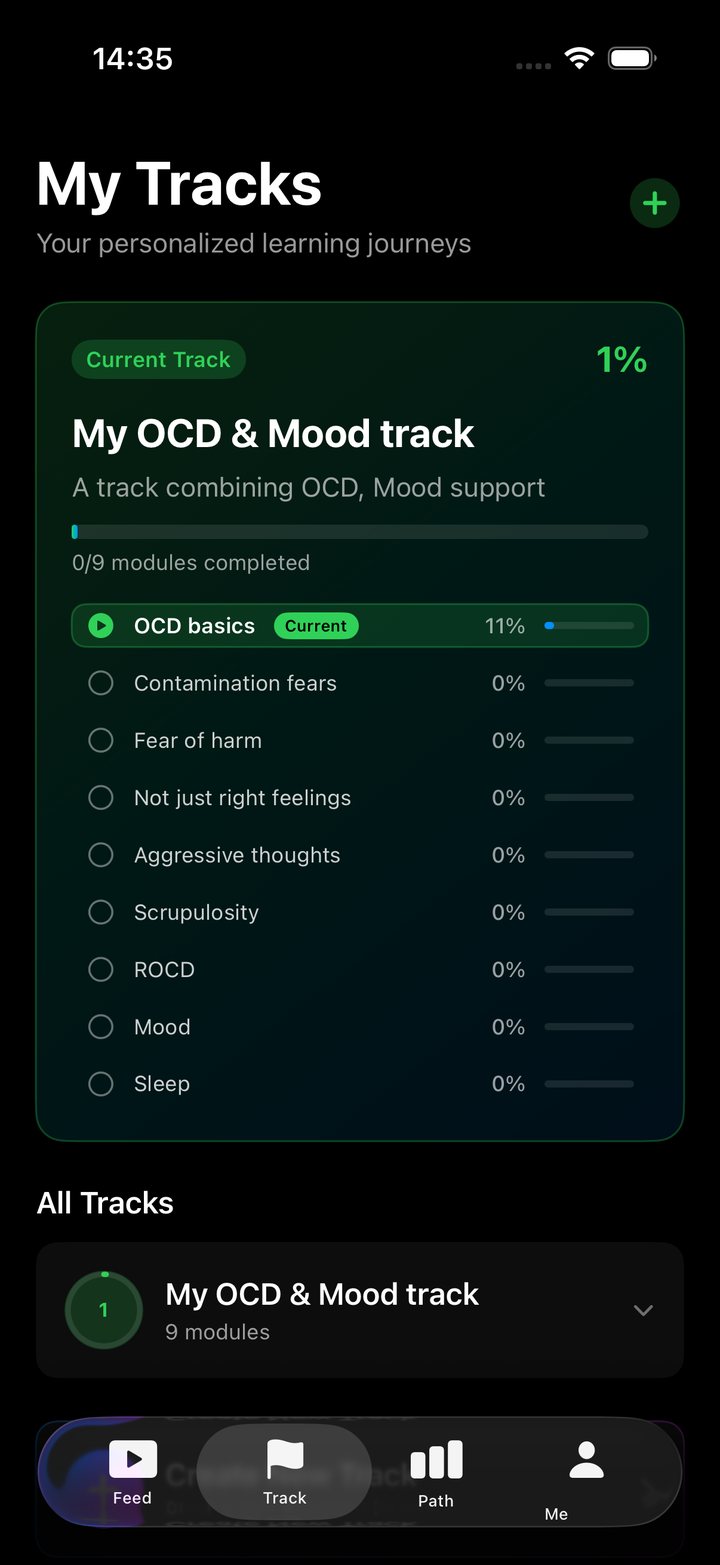
Images: ocd.app / GGtude. Screens and available features may change with app updates.
What the ROCD app research has tested
Several studies evaluated earlier GGRO cognitive-training exercises. The intervention, population and follow-up differ between studies, so their findings should be read separately.
- Roncero, Belloch and Doron (2018): an exploratory open study in students. Twenty participants completed the pre- and post-training assessments. Without a randomised control group, improvement cannot establish that the app caused the change.
- Roncero, Belloch and Doron (2019): a crossover randomised study with 97 students, comparing immediate with delayed use of brief daily exercises. Findings concern the training studied and a student sample.
- Cerea and colleagues (2020): a randomised study with 50 university students with subclinical ROCD symptoms. It examined short daily training and included follow-up. This was not a trial of the full ROCD psychotherapy approach.
- Gorelik, Szepsenwol and Doron (2023): a randomised study involving 103 couples, examining app exercises used by both partners and resilience to ROCD-related difficulties.
These studies support further use and evaluation of brief cognitive training. They do not establish that every current feature or track has been tested, that an app is sufficient for clinical ROCD, or that the complete ROCD psychotherapy integration has been evaluated in an RCT. See our publication library for citations and research summaries.
Thinkable: a separate platform for clinical settings
Thinkable, also from GGtude, currently presents a platform for TMS clinics combining patient coordination, digital exercises and follow-up support. It is a service for clinical organisations rather than a direct substitute for the public ROCD app. Its website distinguishes research on the underlying digital exercises from evaluation of the complete clinic workflow, which is being assessed through a pilot. Contact the provider for availability and scope.
Earlier GG apps: a guide to names in the research
Older papers and posts use the names below. They describe historical apps or research interventions. Their appearance in a publication does not confirm that a separate app is still available or that its exact exercises match a current product.
| Name | Original focus |
|---|---|
| GGRO / GG Relationship | Relationship doubts, obsessional concerns and related beliefs |
| GGOC | OCD-related beliefs and symptoms |
| GGSE | Self-esteem and confidence |
| GGDE / GG Life | Depressive thinking and broader emotional difficulties |
| GGBI | Body-image concerns and related beliefs |
The historical research announcements, development account and original store references are preserved below, alongside the current information on this page.
Using digital exercises in context
An app cannot determine whether a relationship is right, remove the need for uncertainty, or replace an individual assessment. When doubts and compulsions cause distress or interfere with daily life, discuss appropriate care with a clinician familiar with OCD. Our assessment and treatment page explains the wider approach.
Transparency: Prof. Guy Doron is a co-founder of GGtude and a co-developer of the ROCD measures. Links to its products should be understood in that context. External apps have their own accounts, data practices and privacy policies. The no-storage design of the questionnaires on ROCD.net does not describe how an external app handles information.
Historical GG app research and resources
The material below preserves the earlier GG Relationship research announcements and development account. The 2017 announcement is a preliminary description; use the final Roncero, Belloch and Doron (2018) publication linked in the research section above for citation. The 2016 user survey describes associations and does not establish treatment efficacy.
Read the original 2016-2017 research and development account
28.06.2017
A novel way of challenging OCD related beliefs using a mobile-app: An exploratory study.
María Roncero, Amparo Belloch and Guy Doron
Background and Objectives: According to cognitive models, obsessive compulsive symptoms result from catastrophic misinterpretations of commonly occurring intrusive experiences and the use of counterproductive strategies to manage them. Obsessive Compulsive Disorder (OCD) related beliefs such as inflated responsibility, importance of thoughts and perfectionism increases the likelihood of such misinterpretations. Consistent with a growing body of literature supporting the usefulness of mobile delivered technologies in fostering cognitive behavior change, the present study assessed the effectiveness of a novel cognitive training exercise designed to challenge OCD-related beliefs. This mobile app training exercise consists of users having to pull statements challenging OCD beliefs towards themselves (downwards) and to throw away (push upwards) contra-productive self-statements Methods: 36 third-year BA students started the trial. Twenty completed pre and post measures of OCD-beliefs, mood and OCD symptoms including relationship-obsessions. Participants were instructed to complete two minutes of daily training for a period of 15 days. Results: No significant differences were found between completers and non-completers on demographic and symptom related measures at Time 1. Repeated-measures MANOVA of the 20 completers showed a significant reduction on all OCD symptoms measures and on OCD-beliefs. No significant reduction was found in depression symptoms. Regression analysis showed change in levels of OCD-beliefs was associated with reduction in OCD symptoms at Time 2 over and above OCD symptoms at Time 1. Limitations: The study is an open trial with non-clinical participants Conclusions: This mobile delivered training exercise may be useful for the reduction and relapse prevention of OCD-related beliefs and symptoms.
26.08.2016
Does GGRO and with relationships doubts and preoccupations: An initial examination.
We thank all those participating in our pilot study of GGRO! below are the results of the study.
Background: Previous research has linked relationship-related anxieties, doubts and preoccupations (i.e., relationship obsessive compulsive disorder symptoms; ROCD) with reduced functioning, decreased relational and sexual functioning and lower mood. As knowledge of ROCD is emerging, individuals with such symptoms may be frequently misdiagnosed leading to reduced accessibility to adequate treatment. A growing body of literature has supported the usefulness of mobile technology in increasing accessibility to mental health knowledge and in fostering mental health or behavior change. In the present study, we examined associations between relationship related anxieties, doubts and preoccupations (i.e., ROCD symptoms) and the pattern of use of a mobile application named GGRO. This mobile application was designed to challenge maladaptive beliefs related to relationship difficulties. GGRO encourages two minutes of daily training (3 levels a day) over a period of at least 15 days.
Method. Fifty-one users of GGRO responded to a short survey pertaining to application use, satisfaction and relationship-related anxieties and preoccupations.
Results. The number of sessions ranged from 1 to 100 with forty-five participants reporting using GGRO five times or more. Medium-size statistically significant correlations were found between reported number of sessions of GGRO users (i.e., in participants that used GGRO more than 5 times) and relationship-related anxieties and preoccupations (Spearman’s rho r=-.35) suggesting greater number of sessions was related to less such relationship difficulties reported. Similarly, the higher the level participants reported reaching on GGRO (maximum being 45), the less relationship-related anxieties and preoccupations they described (Spearman’s rho r=-.30). Finally, as expected, satisfaction from GGRO was also related to less reported relationship anxieties and preoccupations (Spearman’s rho r=-.45).
Conclusions. Daily use of mobile technology aimed at challenging underlying relationship-related maladaptive beliefs may be associated with reduced relationship-related anxieties and preoccupations.
**********************************
According to Associate Professor Guy Doron and his colleague Gur Ilany, the application developed (named ‘GG Relationship’) was especially designed for dealing with relationship doubts and fears. The application is based on the principles of Cognitive Behavioral Therapy (CBT) – one of the most research-supported psychological therapies.
According to CBT models, negative self-talk – individuals’ ongoing interpretations of the self, others and the world – maintain psychological difficulties such as obsessive preoccupation, low mood, and maladaptive behaviors. In ROCD, for instance, individuals negative self-talk often relates to fear of being in the wrong relationships or/and missing the ‘right’ relationship. Individuals with such fears will continuously say to themselves (in their heads) phrases such as ‘Maybe my partner is not the ONE’, ‘He is not smart enough for me’ or ‘I will regret my decision to stay/leave with my partner forever‘. Such negative self-talk, of course, ultimately increases relationship doubts/fears, intensifies negative mood and often provokes relationship conflict.
Associate Professor Guy Doron says ‘’GG Relationship’ was developed in order to provide an accessible CBT training platform that would allow individuals with relationship fears and doubts to better deal with negative self-talk’. According to Gur Ilany, the application is designed to ‘(1) increase individuals’ awareness of negative self-talk, (2) train individuals’ to better identify and challenge negative self-talk, (3) increase individuals’ access to neutral and positive self-talk, and (4) increase the automaticity of the above processes’. The core gameplay of the training is simple: individuals are presented with ‘blocks’ featuring self-talk statements such as “I am proactive”, “I am reliable” or “I am a loser”- and have to respond by pulling the supportive ‘blocks’ towards themselves (i.e., downwards) and throwing away from themselves the negative ‘blocks’ (i.e., rejecting them upwards).
A/Prof Doron says ‘to further strengthen learning of supportive self-talk, each level the player completes is followed by a small memory game in which one has to identify a supportive statements that appeared in the previous level’. As the game progresses, the individual passes through thematically relevant issues such as self-esteem, beliefs in change, dealing with relationship doubts, facing uncertainty, overcoming perfectionism, coping with embarrassment, commitment anxiety, etc.,. Training using this application, Gur says ‘will hopefully allow for gradual, steady learning of more positive self-talk thereby helping to break the vicious thought cycle maintaining relationship doubts and preoccupations’.
Earlier app-store references from the original directories
These links are preserved as historical references, not as a confirmation of current availability. For current access use the official app website linked above.